The Current State of Project Management Tools
Blog post description.As work becomes faster and more interconnected, project management tools are being asked to do more than record status. This piece explores the current state of PM tools, why they struggle with modern complexity, and how the project manager’s role is shifting toward judgment and situational awareness.
Iyanna Trimmingham
2/9/20263 min read
Project management tools have always reflected how organizations understand work.
For decades, they were built around a simple assumption: decisions happened elsewhere, and the tool’s role was to record the outcome. Plans were entered after meetings. Updates followed conversations. Status reflected what had already changed.
In this model, software functioned as a kind of digital filing cabinet. It was useful for documentation, but largely passive. Tools like Microsoft Project or early spreadsheet-based trackers worked well enough when change was slower and dependencies were fewer.
That model held for a long time.
But today, the environment has outpaced the filing cabinet.
Fragmentation Is the Default State of Work
Most organizations do not lack tools.
They suffer from fragmentation.
Work is spread across task trackers like Jira or Asana, messaging platforms like Slack or Microsoft Teams, document repositories, financial systems, and specialized applications layered on top of one another. Each system captures a slice of reality. None provide the full picture.
Project managers absorb the cost of this fragmentation.
They spend their days:
Reconciling updates across tools
Translating information between systems
Discovering misalignment only after it surfaces as rework or delay
By the time information is synchronized, it is often already outdated. This is not a missing data problem. It is a delayed coherence problem.
The signal exists, but it arrives too late to act on.
From “What Happened” to “What Is Happening”
Traditional project management tools are designed to answer one primary question:
What went wrong?
A task is marked late in a board.
A milestone slips in a plan.
A red status appears in a weekly report.
Those signals still matter. But in fast-moving environments, knowing what happened is no longer enough. What matters is knowing early enough to respond, while trade-offs are still available.
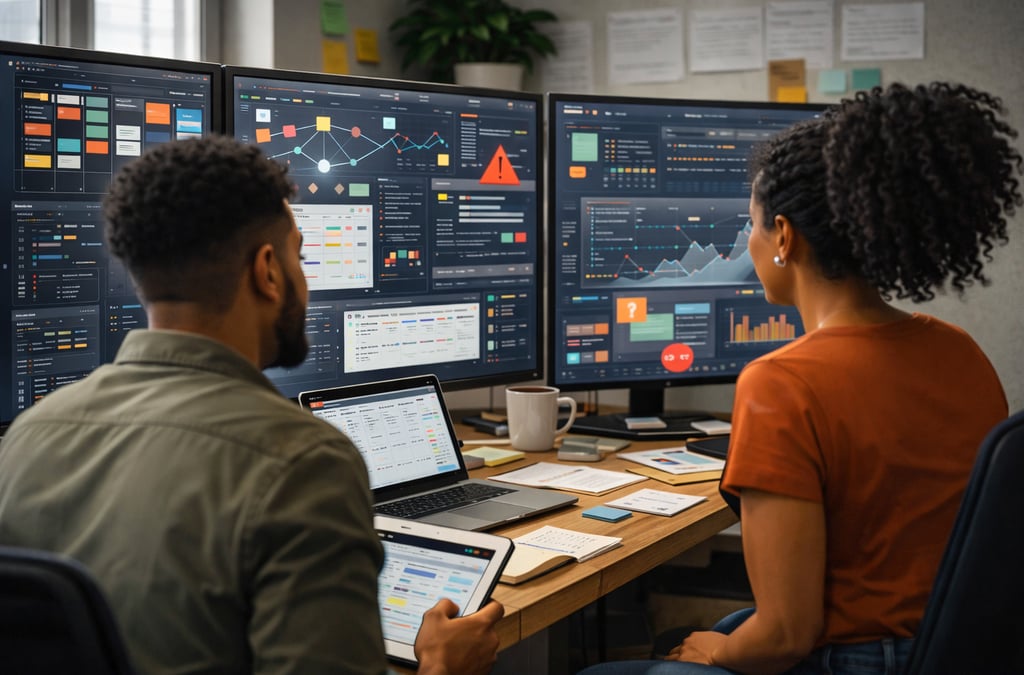
This is why many teams now expect tools to surface issues proactively. When a dependency has not moved for days, or when work queues begin backing up in a Kanban view, the expectation is no longer “log it later,” but “notice it now.”
Because most tools still rely on humans to log changes, project managers compensate with constant vigilance. They check dashboards, monitor channels, and stitch together context across systems that were never designed to speak to one another.
The work subtly shifts.
Instead of managing the project, the project manager ends up managing awareness.
The Limits of Manual Data Entry
For years, project accuracy has been constrained by a simple reality: manual data entry does not scale.
Under pressure, updates get delayed. Details are skipped. Context is lost. Over time, reporting becomes increasingly disconnected from reality.
This produces a familiar pattern. Dashboards look healthy while the project itself is already drifting. Everything appears green right up until it is not.
Modern tools are responding by relying less on manual updates and more on passive observation. Activity-based signals such as changes in shared calendars, stalled pull requests in repositories, or spikes in conversation volume provide early indicators without requiring a project manager to chase status.
This shift does not remove human judgment.
It reduces the overhead required to reach it.
The PMO: From Gatekeeper to Guide
These changes are also reshaping the role of the PMO.
Historically, PMOs enforced governance periodically through stage gates, reviews, and checkpoints applied at defined intervals. In increasingly dynamic environments, that timing often arrives too late to be corrective.
As organizations adopt integrated tool ecosystems, governance is moving closer to the work itself. Instead of reviewing static reports, PMOs increasingly rely on live dashboards, automated controls, and real-time visibility into delivery patterns.
The PMO’s value shifts from enforcing compliance to supporting clarity. It helps teams notice drift early and respond deliberately.
Structure does not disappear.
It becomes more adaptive.
What This Means for the Project Manager
Project management is still about turning uncertainty into forward motion. What has changed is the volume of signals competing for attention and the cost of missing them.
As complexity has outpaced manual oversight, the emphasis of the role has shifted.
Project managers once spent much of their time maintaining systems. They chased updates, reconciled information across tools, and manually kept plans in sync with reality. Today, the work is increasingly about interpreting systems, making sense of the signals that surface, and deciding what they mean for the project’s direction.
Where status once relied on periodic check-ins, the expectation is moving toward continuous situational awareness. Instead of reporting on what already failed, project managers are expected to navigate trade-offs before outcomes are locked in.
Manual coordination is giving way to workflow design. Rather than syncing data by hand, project managers are asked to ensure that information flows reliably and that signals can be trusted. The work shifts from compiling reports to validating what the system surfaces.
None of this removes accountability.
Judgment, context, and responsibility do not disappear in this environment. They become more central. The project manager’s value increasingly lies in deciding what matters, when it matters, and how to respond when conditions change.
Setting the Stage for What Comes Next
Understanding the current state of project management tools explains why conversations about AI feel different now than they did a few years ago.
The goal is no longer simple automation.
It is maintaining clarity as scale and uncertainty grow.
The next generation of tools will not replace judgment.
They will support it under pressure by helping project managers see sooner, think more clearly, and act with intention.